Powered by Blogger.
Showing posts with label Sports Nutrition. Show all posts

How to Build The Perfect Athlete's Plate

One of the most basic questions we get asked as dietitians all the time is "what should I eat?". Its a fairly simple question with a complex answer. However, there are ways to simplify this question, especially when it comes to athletes. The best way to simplify it is by showing you how an athletes plate should look like based on their training regimen.


On easy training days, rest days or if I am trying to focus on weight management (probably during off season) my plate should look like the one noted above. Working less, requires less carbohydrates for energy but more produce to assist with recovery and sustaining health. It should contain:

  • 1/4 grains, ideally whole grains such as whole wheat pasta, brown rice, quinoa, sweet potato, whole wheat bread, etc. 
  • 1/4 protein. Focus on lean protein such as chicken, turkey, fish, lean parts of the beef or pork, tofu, eggs, etc. Prefer grilled, roasted, broiled or baked over fried or pan fried. 
  • 1/2 vegetables and fruits. Example: green beans, roasted beets, salad, sauteed cauliflower, broccoli and carrots, etc.
  • Make sure you always have healthy fats in there such as: olive oil, olives, nuts, seeds, avocado.
  • Hydration is always important. Continue hydrating adequately with mainly water.
  • Example of a whole plate: chicken breast, brown rice with almonds and broccoli or large salad with egg, cheese, pumpkin seeds, lettuce, tomato, onion, cucumber, carrots and cabbage. 
As training increases our plate changes to accommodate more carbohydrates to assist with energy demands of the sport. Moderate training is typically when you have 1-2 training sessions a day that may include one easy workout and a second hard/moderate workout or just one hard workout.
          
This plate should contain:
  • 1/3 grains. As noted before, prefer whole grains. A day before a game or a competition, you might want to consider limiting whole grains so they do not cause a stomach upset.
  • 1/4 protein. As intensity increases we still need enough protein to help rebuild and recover.
  • 1/3+ vegetables and fruits. Variety is important to help fight inflammation, assist with recovery and support a healthy immune system.
  • Continue to incorporate healthy fats.
  • Hydration - keep hydrating appropriately. Weigh before and after practice. For every pound lost, drink 16-20 oz liquid. Sports drinks could be incorporated. See previous post for more specific info on hydration.
Last but not least, when training intensity and duration have increased even more, we focus more on carbohydrates as that is our major source of energy. Hard training or competition day (depending on the sport) is when we have at least 2 workouts a day that are fairly high intensity or if duration is long
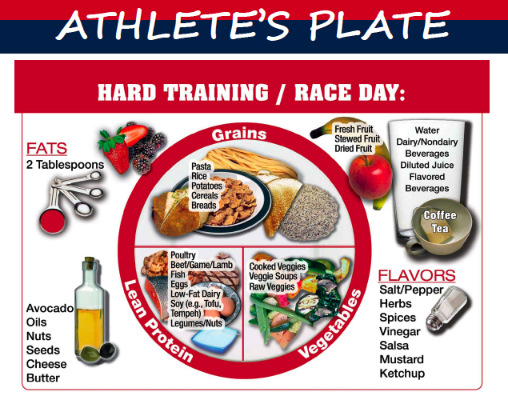
            
This plate should contain:
  • 1/2 grains. The higher the intensity the more we rely on carbohydrates. This plate may need to contain more easily digestible carbohydrates such as regular rice and white pasta vs whole grain to prevent stomach issues.
  • 1/4 protein. As intensity increases we still need enough protein to help rebuild and recover.
  • 1/4 vegetables and fruits. Variety is important to help fight inflammation, assist with recovery and support a healthy immune system.
  • Healthy fats are increased slightly to accommodate inflammation as well as being able to meet calorie goals. 
  • Hydration continues to be very important. See above for recommendations 
As you can see, its quite simple. Whether you cook at home, eat at the dinning hall/training table or eat out, you should be able to build a healthy plate. Hopefully, these visuals have helped. You can also print out this cool education sheet the NCAA Sports Science Institute has created to building a performance plate.  

** Thanks to USOC and UCCS for the great athlete's plate ed material

How to Incorporate More Vegetables in Your Diet

For the college athlete, vegetables and fruits play an important role. Damage and inflammation occur in the body due to exercise and the main way to fight that inflammation is to incorporate more anti-inflammatory foods. Fruits and vegetables are highly anti-inflammatory and should be incorporated on a daily basis. In fact, the athlete has a higher demand for certain vitamins and minerals on top of the need to fight inflammation and therefore, there is a higher recommendation for fruit and vegetable consumption (at least 7 cups a day of fruits and vegetables combined). Most people love fruits and have no issues incorporating them into their daily routine, whether it be in a smoothie, as a snack or as a sweet ending to a meal. However, many struggle with how and where to add all those vegetables.

                
Here are some healthy ways to incorporate more vegetables in your daily routine:

  • For breakfast, add vegetables to your omelette such as spinach, red peppers, onions, mushrooms, tomatoes, etc.
  • If having a breakfast burrito, consider adding salsa.
  • If having a smoothie consider adding things like carrots, beets, kale, spinach, celery, etc. My favorite juice is 50/50 100% orange juice and 100% carrot juice, yum! (note; any smoothie with vegetables needs to have a good balance of fruits as well or else it will taste kind of yucky).
  • Use vegetables as part of your daily snacking for example: carrots and hummus, celery and peanut butter/cream cheese, bell peppers and cottage cheese, tomatoes and Greek yogurt or just a vegetable mix (baby carrots, cherry tomatoes and cucumbers)
  • When making sauces such as tomato sauce add more vegetables to it, for example: saute onion, garlic, zucchini, squash and eggplant and then add the typical tomato sauce you use. That makes for a richer, tastier sauce
  • Use vegetable rich soups such as minestrone and salads as an appetizer. 
  • Try to create a meal based on vegetables. Consider even going meatless for one day. Examples to try: vegetable stir fry, vegetable lasagna, big salad.
                   
  • Have a side of salad each meal. Make sure you have variety so you do not get bored.
  • What ever vegetable you like, take 2-3 servings of it instead of 1. Example: if you like broccoli, have 2 cups of it, not just one.
  • If you like grilling, make sure you always grill some vegetables, whether they are in kabob form or not. See some ideas on previous blog or on Eating Well .
  • Always have cut up vegetables visible so that you will always be reminded they are there and they can be a good grab and go option.
  • Use shredded or pureed vegetables for things like muffins, cakes, meatloaf, meat balls, breads, casseroles, etc. Example of vegetables you can use: sweet potato, zucchini, carrots. Here is a zucchini, carrot apple muffin recipe.
  • When having pizza, make sure you sprinkle more vegetables such as spinach, onion, mushrooms, etc.
  • When you go to a party or dinner be the one that brings the vegetables. Typically that's the one thing lacking from a party.
  • If you are tired and don't feel like cooking, microwave frozen veggies. They are quick and easy. In fact, it's the best "fast food" around.
  • If you enjoy using the slow cooker, almost everything done in it can have added vegetables. Example: add carrots, peppers and squash to your chili. 
  • Stuff vegetables. Example: make stuffed peppers with meat and rice, stuff tomatoes with cauliflower mash and pesto, Stuff mushrooms with garlic, etc. 
  • Add diced vegetables to your tacos.
All vegetables can be incorporated whether fresh, frozen or canned. I am positive there are far more many ways but these healthy ways are all simple and doable. They can help get any athlete to the 7 cups a day recommendation of vegetables and fruits.  Here are some easy recipes to help get you going.

The Importance of Iron for Performance

Iron is one of the most essential trace minerals for athletic performance and the general population. As a college athlete, your body demands extra nutrients, including iron. According to the Academy of Nutrition and Dietetics (AND) endurance athletes, especially long distance runners, have iron needs that are 70% higher than the general population. Iron is also one of the most common nutrient deficiencies seen in athletes, especially women.


Why is iron important?
Iron is essential for energy production, metabolism and to help carry oxygen to the cells. It is also essential for growth, development and the immune system to function normally.

Common causes of iron deficiency:

  • Individuals on vegetarian or vegan diets. Iron is less available in plant-based products.
  • Inadequate energy intake. 
  • Iron loss in sweat, feces, urine, menstrual bleeding, GI bleed, foot-strike hemolysis (with every foot strike we break red blood cells), injury, and blood donation. 
  • Medical disorder that prevents absorption of iron
  • Pregnancy. More demands due to a growing fetus
  • Growth spurt
Symptoms of iron deficiency:
  • Fatigue, irritability, shortness of breath, dizziness, headache, coldness in your hands and feet, pale skin, chest pain and weakness. 
Consequences of iron deficiency: 
  • Reduced endurance
  • Muscle function weakens and ability to work is limited. 
  • Can lead to iron deficiency anemia, which can take 3-6 months to reverse.
Possible benefits of improving iron deficiency: 
  • Improved work volume and endurance. 
  • Improved oxygen uptake. 
  • Decreased lactate concentrations. 
  • Decreased muscle fatigue. 
How to figure out of you are deficient:

A simple blood test allows to figure if you are deficient or not. The most common test is hemoglobin. However, low hemoglobin of < 12 g/dL for women and < 13.5 g/dL for men indicates iron deficiency anemia, which will require supplementation. You can be iron deficient with no anemia. In this case, it is highly recommended to test ferritin levels. Ferritin helps store iron in the body. If it is low, we have low iron stores as well. Although the normal lab values are 12-300 ng/dL in men and 12-150 ng/dL in women, it is found that ferritin below 35 ng/dL in athletes can affect performance and supplementation may be recommended. 

How to improve iron status:

Eat a balanced diet that meets your dietary needs. Women (19-50 years) need a minimum of 18 mg of iron each day and men 8 mg. Consult your doctor or health professional about taking an iron supplement if you do not feel that you can meet your iron needs by diet alone. 


Rich dietary sources of iron: 
  • The most bio-available (best absorbed) sources of iron (also called heme iron): meat, poultry, and fish. 
  • Other sources (plant derived sources are not absorbed as well. Called non-heme Iron): Ready-to-eat cereal, beans, tofu, nuts and dark leafy greens. 
Tips: 
  • Choose breakfast cereals that are fortified with iron 
  • Choose lean meat sources (e.g. Ground beef with less than 10% fat) 
  • Consume iron rich foods with foods high in vitamin C to help your body absorb the iron better (e.g. Oranges, tomatoes, red peppers). 
  • Avoid drinking tea with your iron containing meals. Substances in tea reduce the absorption of iron. 
  • Avoid drinking milk with your iron containing meal.
  • Oxalates and polyphenols are compounds found in certain fruits, herbs, nuts, chocolate and vegetables such as: spinach, kale, tea, beets, strawberries and rhubarb to name a few, that limit absorption of iron from non-heme sources. Cooking the vegetables may assist in preventing this from occuring.  


Guest Contributor: Emily Seidl, MS, RD

The Importance of Breakfast

We have all been told that breakfast is the most important meal of the day. You have probably heard it from your coach, parents, teachers, nurses, doctors and other family members. But have they ever told you why? Although every meal is important, let me tell you why breakfast is:


  • Breakfast means break the fast (fast during sleep). Breakfast kick starts our body's metabolism. More so if we eat good nutrients to start the day. It's like starting a car that has a full tank of gas versus just half a tank.
  • Studies show that students that eat breakfast are able to concentrate better and perform better academically. 
  • Athletes that need to consume a large amount of calories will have a hard time reaching their calorie goals if they skip breakfast. This in turn will hurt performance and could cause undesired weight loss.
  • Breakfast has been shown to help people maintain body weight.
  • Skipping breakfast may cause overeating later on, which in turn can cause weight gain.
  • If you skip breakfast, by the time lunch arrives you are so hungry you eat everything in sight. Research shows that most probably you will reach for the calorie dense, nutrient poor foods such as: fast food and concentrated sweets.
  • Skipping breakfast will probably prevent most people from meeting the daily requirement for the different vitamins and minerals that help us heal and recover post exercise.
  •  People that eat breakfast tend to be more alert throughout the day without having a mid-morning crash.
              
Now that you know why it's so important here are some tips for how to build a good breakfast:
  • Try to have at least 3 food groups, for example: fruits, grains, dairy or protein, grains, vegetables.
  • Focus on whole grains such as oats and whole wheat bread/cereal.
  • Always have a fruit or a vegetable.
  • Try to get 15-30 grams protein. Having a good amount of protein for breakfast helps you feel fuller for longer and prevent over eating as well as help sustain energy.   
  • Drink at least 16-20 oz of fluids, preferably water. Fluids can also be milk, tea, coffee and juice.
  • Prefer eating fruit/vegetables versus juicing as that way you can get the fiber and some nutrients that are lost with juicing.
  • Not all breakfasts can be a sit down breakfast. Nonetheless, grab something for the road such as: apple and cheese stick, granola bar and a cup of milk, smoothie, oats on the go, etc.
Here are some ideas for a healthy breakfast:
  • Whole wheat cereal (Kashi is a great choice) with 1% milk and strawberries
  • Oatmeal with pumpkin seeds, chia seeds and blueberries
  • Scrambled eggs with whole wheat bread and watermelon
  • Smoothie made with: Greek yogurt, strawberries, pineapple, spinach, kiwi, chia seeds and kale
  • Toast with peanut butter and jelly and a cup of milk
  • Sandwich with cheese and avocado and 100% orange juice
  • Yogurt with granola and fruit
  • Leftovers from dinner :)
  • Spinach and feta cheese omelet with toast
  • Muffin with egg, ham, cheese  and spinach and a cup of 100% orange juice
  • Be creative and make sure your plate is colorful! 
Make no excuses and start the day right with a good breakfast! 

Protein for Performance

Athletes literally brutalize themselves during workouts and training sessions. This makes nutrition extremely important for optimal performance, recovery and muscle rebuilding. Both hydration and carbohydrate are important for exercise adaptations and recovery, but it is also important to recognize protein.
            

Protein recommendations for athletes are in the range of 1.2 - 1.7 grams (g) of protein per kilogram (kg) of body weight a day (1 kg = 2.2 lbs) or 0.54 - 0.77 g/lb a day. Recommendations for endurance athletes would be on the low end at 1.2 - 1.4 g/kg (0.54 - 0.64 g/lb) of bodyweight and 1.5 – 1.7 g/kg (0.68 - 0.77 g/lb) for strength and power athletes. For example, an endurance athlete weighing 160 lbs (72.7 kg) would need approximately 87 - 102 grams of protein per day, whereas a 200 lbs (90.9 kg) bodybuilder may require 136 - 170 grams of protein per day. These recommendations may change as some current and emerging research suggests protein requirements may actually decrease in well-trained individuals due to a greater efficiency of dietary nitrogen utilization.

While there are several types of protein, whey protein may be the best choice after a workout. According to Dr. Stuart Phillips, whey protein is more effective than both soy and casein in promoting anabolism (muscle growth) in the fed-state or following exercise. This is due to the high leucine content – a branched chain amino acid – which is a trigger for activating muscle protein synthesis. But when it comes to post workout protein needs, more is not always better. In fact, several studies suggest 20 grams of whey protein (8.6 grams of essential amino acids) is sufficient for most athletes to maximally stimulate muscle protein synthesis. Older athletes may require as much as 40 grams of protein post exercise (16.8 grams of essential amino acids) to maximally stimulate muscle protein synthesis.

Protein consumption before or after exercise is important, but consuming high quality protein spaced evenly throughout the day may be just as essential for optimizing muscle protein synthesis. Throughout the day our bodies go through periods of muscle protein breakdown and muscle protein synthesis. Only when protein synthesis exceeds breakdown, does the growth of muscle mass occur. Therefore, it is important that athletes consume 4 to 5 equally spaced protein containing meals throughout the day versus the typical breakfast, lunch and supper regimen. It is recommended that each meal contains 0.25 - 0.30 g/kg protein. Using our previous example, our 160 lb endurance athlete should aim for 18 – 22 grams of protein per meal and our 200 lb bodybuilder should aim for 23 -27 grams of protein per meal. A protein containing small meal, such as Greek yogurt, prior to bed is also recommended to improve post exercise overnight recovery.

It is highly recommended to choose lean proteins such as: chicken, turkey, fish, lean parts of beef and pork, Greek yogurt and legumes (beans, lentils and chickpeas). In addition, chocolate milk is a great source of whey and could be used as a recovery drink post exercise (20 oz will provide 20 grams protein).

There is no one size fits all approach when it comes to individualized sports nutrition regimens. So always make sure to consult with a sports dietitian to ensure your nutrient needs are met for optimal performance, recovery, and muscle repair. 

Guest blog by: Gavin Van De Walle; SDSU dietetic student and personal trainer

Nutrition for the Injured Athlete

We talk all the time about nutrition for performance and nutrition for recovery but there is not much talk about nutrition for injury. Is there even a specific regimen for the injured athlete?!
Unfortunately, there is not much research out there on the injured athlete so we don't have a specific regimen, however, we do have some knowledge and recommendations to help heal faster and get back in the game sooner.

Injury has 3 healing phases:

  1. Inflammation - occurs immediately up to 2-5 days post injury
  2. Proliferation -  occurs 5 days - 3 weeks post. During this phase there is rebuilding and repairing 
  3. Maturation - occurs 3 weeks - 2 years (depending on severity of injury). During this phase there is remodeling to a stronger structure
If the injury is serious we may not be able to immobilize which in turn will cause less muscle building, muscle loss, decrease in strength and of course decrease in performance.  
Nutritionally, we divide recommendations to 2 phases: 
  1. Injury and immobilization - during this phase most of the muscle loss occurs
  2. Rehabilitation - during this phase exercise is re-introduced in the form of therapy and advanced to full practice when able
Nutrition recommendations during Injury and immobilization (= inflammation and proliferation phase of healing):
  • Energy (kcal) - demands of energy are slightly higher in order to assist with the healing processes. If injury is severe, energy expenditure can go up by 20%. If on crutches, energy expenditure can be 2-3 times higher than walking. Sometimes, a small weight gain is beneficial because with out enough calories we can prevent muscle protein synthesis (building muscle)
  • Protein - During the immobilization phase we lose muscle which then causes us to lose strength. Protein helps us build and repair, therefore, are needs for protein are higher. Although we do not have an exact number of grams/lb we need per day, we assume its more than the DRI (dietary reference intake) which is 0.8 grams/kg (0.35 grams/lb). Some research suggests we need close to 1-1.2 grams/kg/day (0.45-0.55 grams/lb/day). Since the majority of us eat more protein than we need this should not be an issue
  • Carbohydrates - When we exercise, carbohydrates are our main source of energy. However, when injured, we don't need as much, therefore, we may decrease carbohydrates slightly to prevent excessive weight gain. Sports beverages, gels, sodas and concentrated sweets are highly discouraged during this time
  • Fats - very essential for healing. What type of fats is most important. Omega 3s (found in fatty fish as well as certain seeds/nuts) have been found to possibly help increase muscle protein synthesis (building muscle) as well as help with recovery and decreasing inflammation
  • Vitamins and minerals:
               * Vitamin C - Helps with wound healing, tissue repair and increased immune function. Foods rich in vitamin C include: citrus fruit, strawberries, red bell peppers, watermelon, etc.
               * Vitamin A - Helps with cell growth and development as well as immune function. Foods high in vitamin A include: sweet potatoes, tomatoes, carrots, papaya (orange/red fruits and vegetables)
               * Zinc - Helps with wound healing, protein synthesis and immune function. Foods rich with zinc include: beef, almonds, seeds (sunflower, flax, pumpkin, etc.) and seafood
               * Vitamin D - Important for bone health and immune function. The sun vitamin - get 5-30 minutes of sun between 10 AM - 3 PM (time is based on skin color, the darker the skin the more time you need) or it can be found in dairy products, fatty fish or fortified foods
                      
  • Fluids - fluids are needed in order to deliver the different nutrients to the different organs and tissues. Moreover, its needed to support joints and soft tissues. Roughly, you should be drinking half your weight in ounces, preferably water. 
Nutrition during rehabilitation phase
We treat this phase as we were to treat someone who does strength and conditioning. We put emphasis on enough energy and protein as well as healthy fats and plenty of vegetables and fruits. More on strength and conditioning nutrition in a future blog.

There are also foods/beverages that can prevent us from healing optimally, which we should avoid:
  • Fried fatty foods (example: pizza, fried chicken, french fries, etc.)
  • Added sugars and concentrated sweets (soda, candy, ice-cream, etc.)
  • Being malnourished (more common in elderly but applies to people that restrict eating a lot)
  • Less than optimal sleep (athletes should sleep 8-10 hours/day)
  • Alcohol - it inhibits muscle protein synthesis and increases muscle loss 
So, if you or any of your friends get injured, remember to also focus on nutrition to help speed your healing and recovery! Food always comes first and if need be, consult a sports RD or a sports MD for supplement recommendations.


Soccer Nutrition

As you might have noticed, the world cup just started and it seems as though everyone is watching.
It took enormous amounts of training to get there and now it will take a lot to stay at the top. One of the more important ways to stay at the top, besides good players of course, is nutrition and rest. For those who don't know, only 2 teams brought their dietitian with them to Brazil. Team USA and the team from Italy (you can read more about what they are doing here). Therefore, I thought it would be appropriate to talk about sports nutrition strategies in soccer.

Soccer has a combination of endurance exercise and intense short burst sprints. Professional players that play most of the game, may cover up to 10-13 km (6-8 miles) with multiple sprints in between. Therefore, the main source of energy they utilize is carbohydrate. Athletes who do not consume enough carbohydrates and are insufficiently hydrated will not be able to train and/or compete at high intensities and will likely experience premature fatigue. 
Our nutrition strategy will focus on pre-during-post- activity:

Pre-activity/game nutrition depends on how soon my activity is:
Pre-activity meal (3-4 hours before):
-          High in carbohydrate
-          High in lean protein
-          Low in fiber and fat
-          12-20 fl. oz (e.g., milk, juice, sports drink)
Example:  Grilled chicken, brown rice, corn, green beans, salad and vanilla pudding.

Pre-activity snack (30-60 minutes before)
-          30-60 grams of easily digestible carbohydrate
-          Moderate in protein
-          Low in fiber and fat
-          5-16 fl. oz (e.g., water, sports drink)
Example: Banana & peanut butter, yogurt & small amount of granola, cereal & milk, granola bar, etc.

During activity depends on length of activity and whether you have one session or more per day:
 If activity is less than 60-90 minutes and that is the only session of the day:
-   hydrate with 5-10 oz of water every 15-20 minutes.
 If activity is more than 60-90 minutes and/or you have multiple sessions a day:
-          Drink 5-10 oz of fluid every 15-20 minutes (preferably a sports drink)
-          Consume 30-60 grams of carbohydrate every hour (by drinking or eating)
-          During half-time (or similar break), eat a simple carbohydrate snack with limited amount of protein, low in fiber and fat
-          Consume snacks that contain sodium (salt)  
Example: Banana, pretzels, crackers, beef jerky and/or a sports drink.

Post activity/Recovery
Recovery starts fairly close to when you finish your activity; therefore, within about 30-45 minute,
- focus on protein and carbohydrate foods and/or drinks. 
Example: Chocolate milk, Greek yogurt and a banana, recovery shake
Post-activity meal (1-2 hours after)
-          High in whole grain carbohydrates
-          High in lean protein
-          Good amount of fiber and fats
-          16-24 fl. oz (e.g. chocolate milk, smoothie, sports drink, water)
Example: 6”-12” sandwich with turkey, cheese & vegetables, trail mix, and oatmeal cookie.

Note - if you will have a meal within an hour post activity/game a recovery drink is not needed. However, if you are not hungry right after and there may be some time before your next meal, a recovery drink is important.

For hydration recommendations please refer to our previous post on that topic.

Remember, the right hydration and nutrition plan can really be a game changer, so make sure you fuel appropriately for your sport pre, during and after activity.

GO TEAM USA!
ole, ole, ole, ole, ole, ole ....................